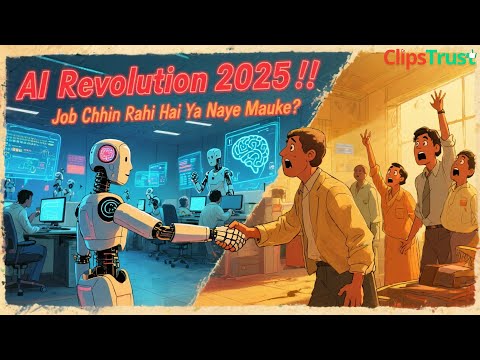




In This Video: AI Revolution 2026 – Jobs Ending or Creating Opportunities?
In this video, we expose the complete truth about AI's impact on the job market in India by 2026, going beyond the hype with hard facts and data-driven analysis. Major tech companies like TCS, Infosys, Ola, and Wipro are simultaneously firing thousands while hiring and training others in AI creating a confusing picture that demands clarification. This comprehensive video about AI revolution 2026 answers whether AI will steal jobs or create new opportunities for millions earning potential.
We'll demonstrate that the real question isn't whether AI will replace your job, but which side you'll be on those losing jobs to AI or those winning alongside it. Through concrete examples and real industry data, we reveal how India's unique position as a young, tech-savvy, affordable labor force creates unprecedented opportunities for job transformation by 2026. Understanding how AI will change jobs in future requires grasping this pivotal moment before your career path is decided.
Queries Solved in This Video
Will AI replace jobs in India by 2026? Analyzing layoff data from TCS (12,000 employees), Infosys, Ola, and Wipro to understand the real displacement numbers
Is AI dangerous for jobs in India? Identifying the highest-risk job categories and examining which professionals face immediate threats
How AI will change jobs in future – what roles will vanish? Understanding why BPO, call center, data entry, junior developers, and content creation roles are most vulnerable
How AI will change jobs in future – what new opportunities are emerging? Exploring 38 million new jobs being created worldwide while 30 million disappear
Best AI Tools for Digital Marketing – Listed Free & Paid Tool for Digital Marketers Discussing AI applications transforming content creation, design, and marketing analysis
The Complete Steps to AI in Digital Marketing How digital marketers should adapt using AI-powered tools for competitive advantage
Why aren't middle managers safe from AI displacement? Understanding AI's capacity for superior analysis, recommendations, and data presentation
What are the fresher-friendly AI jobs requiring no coding experience? Revealing 50% of new AI roles are designed for entry-level professionals with no technical background
Video Timestamps According to Actual Timing (4:32 min)
0:00 – Introduction to AI Job Displacement Crisis
Opening with shocking numbers: TCS fired 12,000 employees, Ola cut 1,500 workers, Wipro reduced fresher offers from ₹6.5 lakh to ₹5 lakh, yet Infosys simultaneously hired 20,000 new employees, creating confusion about AI's true job market impact.
0:21 – The Central Question About AI and Employment
Framing the core issue: AI is simultaneously taking and creating jobs, so the real question becomes whether you'll join those losing jobs to AI or gaining opportunities with AI technology.
0:42 – Three Audience Categories and Career Implications
Identifying three viewer groups: students worried about career prospects, employed professionals fearing job loss, and those already leveraging AI to gain unfair advantages in their fields.
1:00 – Comparison to 1991 Economic Liberalization
Drawing parallels to India's 1991 economic liberalization when the entire nation transformed overnight the AI revolution represents an equally dramatic shift in employment landscape.
1:19 – Global Job Creation vs. Displacement Statistics
Presenting hard numbers: By 2026, AI will create 38 million new jobs worldwide but eliminate 30 million existing positions, making the question about being on the winning or losing side.
1:49 – Indian Tech Companies' Layoff Data
Documenting that Indian tech companies laid off 1.5 lakh (150,000) employees in the past two years, yet simultaneously trained 3 lakh (300,000) others in AI, demonstrating the dual transformation occurring.
2:06 – Most Threatened Job Categories Analysis
Identifying BPO sectors, call centers, data entry operators, junior graphic developers, designers, content writers, and video editors as highest-risk roles due to AI's superior speed and efficiency.
2:22 – How AI Outperforms Repetitive Work
Explaining how AI executes repetitive tasks faster, without fatigue, without salary costs creating the primary threat to routine-based employment.
2:32 – Middle Management Vulnerability
Addressing the shocking truth that middle managers aren't safe because AI delivers better analysis, recommendations, and data presentation than traditional postman-style management roles.
2:43 – The Bifurcation: AI Creators vs. AI Users
Revealing that ultimately, only two categories remain: those who build AI and those who use it everyone else falls into the displacement risk zone.
3:02 – The Positive Turning Point
Introducing the counterbalance: new AI-related roles are simultaneously being created where old jobs disappeared, with half these positions open to freshers requiring zero coding experience.
3:18 – AI Startup Funding and Government Investment
Highlighting ₹780 million in AI startup funding during 2024 and government's ₹10,000 crore AI investment plan, indicating massive opportunity creation.
3:30 – Major Tech Companies' AI Training Programs
Noting that Infosys trained 2.7 lakh employees in AI, while Wipro and TCS are also conducting massive upskilling across their entire workforce.
3:50 – India's Competitive Advantages for AI Boom
Emphasizing India's perfect positioning: 5.4 million IT professionals, 32 million English speakers, average workforce age of 27 years, young talent, smart capability, and affordable labor costs.
4:09 – The Democratization of AI Entrepreneurship
Demonstrating how anyone with a laptop and internet connection can now build AI-powered applications, work with global clients, and launch startups from small towns completely transforming employment possibilities.
4:32 – The Final Call to Action
Concluding that the choice is clear: either AI becomes your boss by 2026, or you can build your own position leveraging AI encouraging immediate action before the window closes.
Video Chapters Breakdown
Chapter 1: The Contradictory Reality of AI in Tech (0:00-0:42)
This opening segment addresses the confusing signals from India's tech sector where massive layoffs coincide with massive hiring, creating confusion about whether AI truly threatens employment or creates opportunity.
Topics Covered:
- TCS eliminating 12,000 employees while other companies expand
- Infosys hiring 20,000 new workers simultaneously
- Wipro cutting fresher salary packages but maintaining hiring
- The apparent contradiction demanding clarification
- Setting up the central question about which direction employees will follow
Chapter 2: Understanding the Global AI Job Transformation (0:42-1:49)
Deep dive into how the AI revolution parallels India's 1991 economic liberalization in its transformative scope, examining global statistics on job creation versus displacement through 2026.
Topics Covered:
- Historical comparison to 1991 liberalization's transformative power
- 38 million new jobs being created globally by AI
- 30 million jobs disappearing simultaneously
- The reframed question: being on the losing or winning side of AI
- Indian tech companies' actual layoff statistics (1.5 lakh in two years)
- Simultaneous training of 3 lakh workers in AI skills
- The dual nature of transformation occurring right now
Chapter 3: Identifying High-Risk Job Categories (1:49-2:43)
Detailed analysis of which professions face immediate AI displacement threats, examining the specific characteristics that make certain roles vulnerable to automation.
Topics Covered:
- BPO and call center sectors as primary risk zones
- Data entry operators facing obsolescence
- Junior graphic developers and designers threatened by AI
- Content writers and video editors competing with AI-generated content
- Why repetitive tasks are most vulnerable to AI automation
- AI's ability to work faster, without fatigue, without salary requirements
- Middle management vulnerability despite perceived job security
- The postman-style management roles most threatened by AI
Chapter 4: The Opportunity Side of AI Transformation (2:43-4:09)
Balancing the displacement discussion with genuine opportunities emerging from AI adoption, explaining how new roles create pathways for career growth and entrepreneurship.
Topics Covered:
- New AI-related roles being created in place of displaced jobs
- 50% of new AI positions open to freshers with no coding experience
- ₹780 million in AI startup funding during 2024
- Government's ₹10,000 crore AI investment plan announcement
- Infosys training 2.7 lakh employees in AI skills
- Wipro and TCS upskilling efforts across their workforce
- India's competitive advantages: 5.4 million IT professionals, 32 million English speakers, average age 27
- Young, smart, and affordable labor positioning for AI boom
- Democratization of AI entrepreneurship with laptop and internet
- Building AI-powered applications from small towns for global clients
- Fresh opportunities for work from home and side hustles
Chapter 5: Future Positioning and Decision Making (4:09-4:32)
Concluding segment focusing on individual choice and agency in determining whether AI becomes your boss or your tool for building opportunities.
Topics Covered:
- The binary future: employees of AI or entrepreneurs with AI
- Importance of immediate action and skill development
- Learning AI tools, taking courses, weekend experimentation
- Becoming future-ready before 2026 arrives
- The decision point for each viewer
- Final call to subscribe and engage with community opinions
Key Highlights of the Video
- Simultaneous Layoffs and Hiring: Major tech companies like TCS, Infosys, and Wipro are firing employees while hiring others, indicating massive job restructuring rather than simple elimination.
- Global AI Job Market Statistics: By 2026, AI will create 38 million new jobs globally while eliminating 30 million existing positions meaning transformation rather than net job loss.
- Indian Tech Company Layoff Reality: 1.5 lakh (150,000) employees laid off by Indian tech companies in the past two years, but simultaneously 3 lakh (300,000) workers trained in AI skills for new roles.
- Most Vulnerable Job Categories: BPO sectors, call centers, data entry operators, junior developers, graphic designers, content writers, and video editors face the highest displacement risk from AI automation.
- AI's Performance Advantages: AI executes repetitive tasks faster than humans, without fatigue, without salary requirements, and without making mistakes creating fundamental competitive pressure on routine work.
- Middle Management Vulnerability: Surprisingly, middle managers aren't safe because AI delivers superior analysis, recommendations, and data presentation compared to traditional management decision-making.
- The Great Bifurcation: In the future, only two categories exist those building AI systems and those using AI systems making the middle ground increasingly untenable for employment.
- New Opportunities for Freshers: 50% of emerging AI-related jobs require no coding experience, only understanding, learning ability, and hands-on application opening pathways for entry-level professionals.
- Massive Funding and Investment: ₹780 million in AI startup funding during 2024 plus ₹10,000 crore government investment plan indicate enormous opportunity creation alongside displacement.
- India's Strategic Positioning: With 5.4 million IT professionals, 32 million English speakers, average workforce age of 27, and affordable labor costs, India is perfectly positioned for an AI boom.
- Democratized Entrepreneurship: Anyone with a laptop and internet can now build AI-powered applications, serve global clients, and launch businesses from small towns completely transforming employment possibilities.
- 2026 Decision Point: The real choice by 2026 is whether AI becomes your boss or you use AI to become your own boss requiring immediate skill development and action today.
Video Description: Comprehensive Overview
The AI Revolution 2026 video presents an unfiltered analysis of how artificial intelligence will fundamentally reshape India's employment landscape. Rather than providing sensationalized predictions, this comprehensive examination provides hard data, real examples, and practical implications for three distinct audience categories: students building careers, employed professionals protecting positions, and entrepreneurs creating the future.
Understanding AI's True Job Market Impact:
The apparent contradiction between massive tech industry layoffs and simultaneous hiring becomes clear when examining the underlying transformation. Companies like TCS eliminated 12,000 employees while training thousands of others indicating a shift toward AI-augmented roles rather than complete elimination. This pattern repeats across Infosys, Wipro, and other major employers, revealing that the real story is job transformation, not job apocalypse.
Which Jobs Face AI Displacement:
Certain profession categories are fundamentally threatened because they rely on repetitive, pattern-based work exactly what AI excels at performing. BPO agents, call center operators, data entry specialists, junior graphic designers, content writers, and video editors represent the frontline of displacement. These professionals compete directly with AI systems that work faster, never tire, never demand salary increases, and make fewer mistakes.
Why Middle Management Must Pay Attention:
The shocking vulnerability of middle management roles challenges the assumption that seniority provides job security. AI systems now deliver superior analysis, generate better recommendations, and present data more compellingly than traditional middle managers. In "postman-style" management roles where instructions flow from above to be pushed downward AI automation represents an existential threat.
The Opportunity Side That Media Ignores:
While job displacement receives headlines, the simultaneous creation of new positions receives minimal coverage. By 2026, global AI development will generate 38 million new employment opportunities while eliminating 30 million existing roles. India stands to benefit disproportionately from these new positions given its unique advantage: 5.4 million IT professionals, 32 million English speakers, young workforce average age of 27, smart talent, and affordable labor costs.
Fresher-Friendly AI Jobs with Zero Coding Requirements:
Remarkably, 50% of newly created AI-related positions require no coding experience only understanding, learning ability, and hands-on application skills. This democratization of AI opportunities creates pathways for career switching, upskilling, and entrepreneurship previously unavailable to non-technical professionals.
Government and Private Sector Support:
India's AI ecosystem receives unprecedented support through ₹780 million in startup funding during 2024 alone, plus a ₹10,000 crore government-approved AI investment plan. Tech giants Infosys trained 2.7 lakh employees, Wipro and TCS engaged in similar mass upskilling create acceleration for the transformation.
The Democratization of Entrepreneurship:
Perhaps most revolutionary: anyone with a laptop and internet connection can now build AI-powered applications, launch startups, and serve global clients from small towns. This fundamentally changes employment from being dependent on company hiring decisions to being independent through entrepreneurship.
The 2026 Decision Point:
By 2026, the binary choice becomes clear: either AI becomes your boss, determining your employment destiny through displacement, or you master AI tools, become your own boss, and create opportunities. This video provides the framework for making that choice proactively rather than reactively.
Why This Video is Beneficial for Viewers
The ClipsTrust research and expert team created this AI Revolution 2026 video to provide critical perspective during a pivotal career moment when algorithmic disruption accelerates exponentially. Traditional career advice becomes obsolete when automation transforms entire industries within 18 months yet most professionals receive zero guidance on navigating this transformation.
This video delivers practical value by replacing anxiety with actionable intelligence. Rather than presenting AI as an abstract threat, we provide specific job categories facing displacement, concrete examples of companies already executing this transformation, and realistic pathways for staying competitive. Students gain clarity on career direction before investing years in potentially vulnerable fields. Employed professionals receive warning signals and adaptation strategies. Entrepreneurs discover the unprecedented opportunity window now open for AI-powered businesses.
The framework provided here understanding job vulnerability, recognizing opportunity areas, leveraging India's competitive advantages, and taking immediate action applies across all career stages and backgrounds. By watching this analysis, viewers transform from passive observers of AI disruption into active architects of their professional futures.
Comparative Tables: AI Job Impact Analysis
Table 1: Tech Company Hiring vs. Firing Patterns (2024-2025)
| Company | Employees Fired | Employees Hired | Net Impact | Salary Changes |
|---|---|---|---|---|
| TCS | 12,000 | Training 300,000+ | Restructuring | Reducing junior packages |
| Ola | 1,500 | Not specified | Contraction | Competitive pressure |
| Wipro | Unknown | Active hiring | Mixed | Freshers: ₹6.5L → ₹5L |
| Infosys | Unknown | 20,000+ new hires | Expansion | AI specialists premium |
| Industry Total | 150,000 | 300,000+ trained | Transformation | Market-driven adjustment |
Table 2: Job Vulnerability vs. AI Opportunity Index
| Job Category | Displacement Risk | AI Opportunity | Fresher Friendly | Timeline |
|---|---|---|---|---|
| BPO/Call Centers | Very High | Low | No | 2025-2026 |
| Data Entry | Very High | Low | No | Immediate |
| Junior Developers | High | High | Yes | 2025-2027 |
| Graphic Designers | High | High | Yes | 2025-2026 |
| Content Writers | High | Medium | Yes | 2025-2026 |
| Video Editors | High | Medium | Yes | 2025-2027 |
| Middle Managers | Medium | Medium | No | 2026+ |
| AI Specialists | None | Very High | Yes | Immediate |
| AI Tool Users | None | High | Yes | Immediate |
| Entrepreneurs | None | High | Yes | Immediate |
Table 3: India's AI Competitive Advantages vs. Global Competitors
| Metric | India | China | USA | Europe |
|---|---|---|---|---|
| IT Professionals | 5.4 Million | 1.5 Million | 2.2 Million | 1.8 Million |
| English Speakers | 32 Million | 5 Million | 280 Million | 200 Million |
| Average Workforce Age | 27 years | 35 years | 38 years | 41 years |
| Labor Cost | Low (Affordable) | Medium | High (Expensive) | Very High |
| Tech Talent Availability | Abundant | Limited | Limited | Limited |
| AI Startup Ecosystem | Growing Rapidly | Mature | Mature | Mature |
| Government Support | ₹10,000 Cr Plan | Heavy Investment | Moderate | Moderate |
| Perfect Storm Status | YES (All factors align) | Partial | Partial | Partial |
Related Topics for Career Development
Will AI replace jobs in India by 2026 is fundamentally connected to broader professional growth themes. Similar to understanding job market dynamics, learning best AI tools for digital marketing – listed free & paid tool for digital marketers empowers professionals to stay competitive. Digital marketers who understand the complete steps to AI in digital marketing gain significant advantage over those ignoring this transformation.
The success stories of entrepreneurs like Chandubhai Virani success story of Balaji Wafers demonstrate how seizing market opportunities creates generational wealth principles now applying to AI opportunities. Understanding 7 secret habits of billionaires success guide 2026 reveals patterns of proactive adaptation, rapid decision-making, and continuous learning exactly what AI disruption demands.
For professionals exploring alternative income streams, work from home jobs for housewife without investment exemplifies how technology democratizes opportunity, allowing anyone to build income independent of traditional employment. The journey of Gautam Adani from college dropout to global billionaire shows that formal credentials matter less than identifying opportunities, taking action, and leveraging market shifts lessons directly applicable to today's AI revolution.
Conclusion
The AI Revolution 2026 video reveals that the real question isn't whether AI will eliminate jobs it's whether you'll be among those displaced or those thriving alongside this transformation. India's unique position as the world's youngest major economy with abundant tech talent, affordable labor, strong English proficiency, and government support creates unprecedented opportunity for those who act now.
Will AI replace jobs in India by 2026? Yes but it will also create new jobs. The key differentiator is proactive adaptation. The ClipsTrust expert team emphasizes that waiting for clarity only guarantees being caught unprepared. Those learning AI tools, taking certification courses, experimenting on weekends, and building skills today become indispensable by 2026. Those assuming job security based on current position face the highest displacement risk.
Is AI dangerous for jobs in India? Only for those ignoring the transformation. For those embracing it, AI represents unprecedented opportunity to increase income, build global client bases, launch startups from small towns, and create generational wealth.
How AI will change jobs in future depends entirely on your decisions today. The democratization of AI entrepreneurship means anyone with determination, a laptop, and internet connection can build their future independent of company hiring decisions. By 2026, the choice becomes stark: either AI becomes your boss, or you leverage AI to become your own boss. The time for decision is now.
Video Disclaimer
This AI Revolution 2026 video presents analysis based on publicly available data, industry reports, government announcements, and expert commentary as of December 2025. The information provided is for educational and informational purposes to stimulate informed thinking about career preparation and professional adaptation.
This content is not investment advice, employment guidance, or prediction of future guaranteed outcomes. The AI job market remains dynamic with variables beyond anyone's full control. Viewers should conduct independent research, consult career counselors, and make decisions based on their personal circumstances, qualifications, and goals.
Past hiring/firing patterns and current trends don't guarantee future employment dynamics. Government policies, technological breakthroughs, global economic conditions, and company strategies constantly evolve. This analysis represents one informed perspective at a specific point in time and should not be treated as definitive career or financial guidance. Individual outcomes vary significantly based on skill development, market timing, geographic location, and personal initiative.
Leave a Comment For the Above Video