
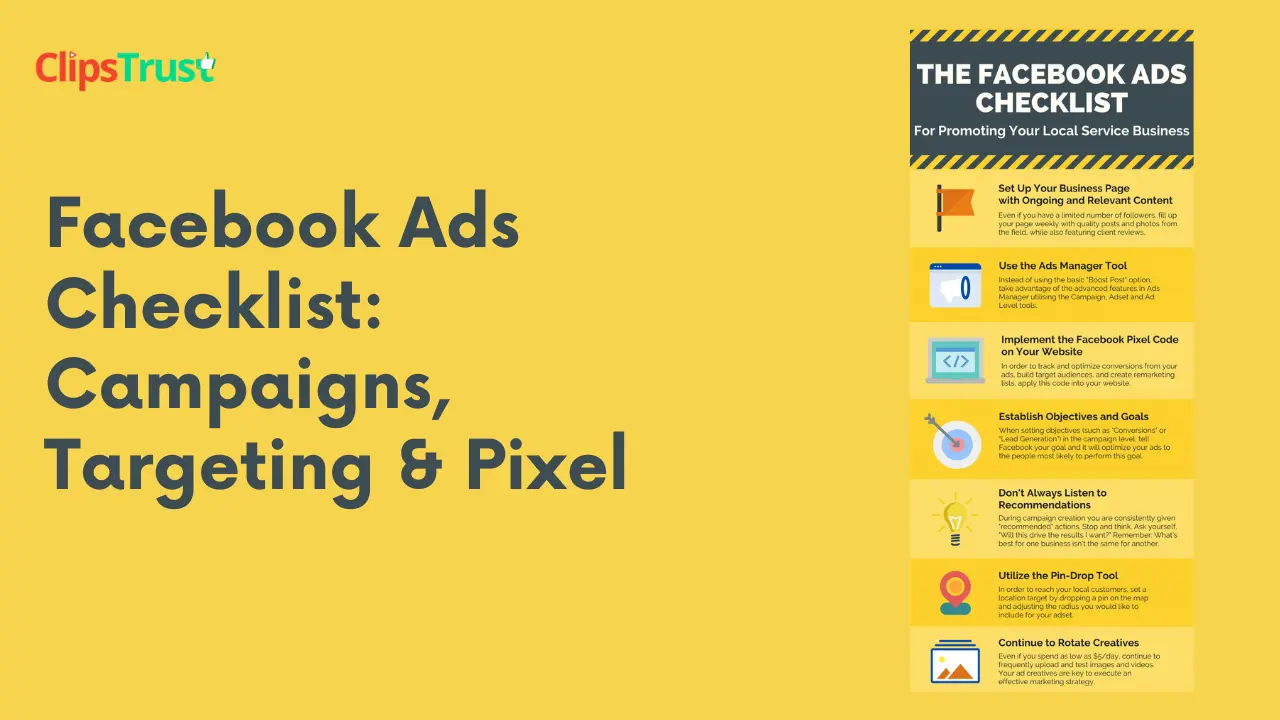
Facebook Ads Checklist : Campaigns, Targeting & Pixel

Table of Contents

    What You Will Learn

    • How Facebook Ads (Meta Ads) work and why they are different from Google Ads
    • Facebook Ads campaign structure — objectives, ad sets, and ads
    • Audience targeting — Custom Audiences, Lookalikes, and interest targeting
    • Facebook Ad formats and which to use for your goal
    • How to install the Meta Pixel and set up conversion tracking
    • Facebook Ads cost in India and how to reduce your cost per lead

    Keywords covered:

    facebook ads guidefacebook ads for beginnersmeta ads guidefacebook ads indiafacebook advertising tutorialhow to run facebook adsfacebook ads audiencefacebook pixelinstagram ads guidemeta ads managerfacebook ads cost indiafacebook custom audienceslookalike audiencesfacebook ads campaignfacebook lead generation ads
    facebook ads checklist

    Facebook Ads vs Google Ads — Understanding the Key Difference

    Before diving into Facebook Ads, understanding the fundamental difference between Facebook (Meta) Ads and Google Ads is essential for knowing when and how to use each.

    FactorGoogle AdsFacebook/Meta Ads
    Targeting basisWhat users are searching for (intent-based)Who users are (demographic, interest, behaviour)
    User mindsetActive intent — actively looking for solutionPassive discovery — browsing feed, not actively searching
    Best forCapturing existing demandCreating new demand and awareness
    Ad formatPrimarily text (search ads)Visual — image, video, carousel, stories
    India CPC averageRs 10–100Rs 2–30
    Audience sizeLimited by search volumeMassive — 350M+ Indian users on Meta platforms
    Funnel stageBottom of funnel (ready to buy)All funnel stages (awareness to conversion

    The most effective strategy uses both: Google Ads to capture users actively searching for your service, and Facebook/Instagram Ads to build brand awareness, nurture audiences, and retarget website visitors.

    Facebook Ads Campaign Structure

    Meta Ads are organised in three levels:

    LevelWhat You SetKey Decisions
    CampaignObjective, campaign budget (optional)Choose the objective that matches your business goal — this determines optimisation
    Ad SetAudience, placement, schedule, budgetDefine who sees your ad, where, when, and how much to spend
    AdCreative — images, video, copy, CTA buttonThe actual ad users see — test multiple formats per ad set

    Campaign Objectives — Choose the Right One

    ObjectiveFacebook Optimises ForUse When
    AwarenessMaximum reach and brand recallLaunching a new brand or product; building top-of-funnel
    TrafficClicks to your websiteDriving blog or product page visitors (use with Pixel for retargeting)
    EngagementPost likes, comments, shares, page followsBuilding social proof; growing your page
    Lead GenerationInstant form completions within FacebookCollecting leads without a landing page — great for mobile users in India
    App InstallsMobile app downloadsGrowing your app user base
    ConversionsWebsite conversions tracked via PixelPurchases, registrations, form completions on your website
    Catalog SalesDynamic product ad displaysE-commerce — shows relevant products to each user

    Audience Targeting — The Heart of Facebook Ads

    1. Core Audiences (Interest and Demographic Targeting)

    Target users based on location, age, gender, interests, and behaviours. This is the starting point for new advertisers.

    • Location: Target by country, state, city, or radius around a pin (“people within 10km of our office”)
    • Demographics: Age, gender, education, job title, relationship status, income level
    • Interests: Pages users follow, content they engage with (e.g., “interested in digital marketing”, “interested in business software”)
    • Behaviours: Purchase behaviours, device usage, travel patterns, business decision-maker status

    Audience size guidance: 200,000 — 2,000,000 is the ideal range for most Indian business campaigns. Too small = limited reach. Too large = poor targeting efficiency.

    2. Custom Audiences — Your Warmest Targeting

    Custom Audience TypeHow It WorksROI Potential
    Website VisitorsPixel tracks visitors; target anyone who visited your siteHighest — they already know you
    Customer ListUpload email/phone list; Facebook matches to user accountsVery High — existing customers for upsells
    Video ViewersTarget people who watched 25%, 50%, or 95% of your videosHigh — engaged and aware of your brand
    Page EngagersTarget people who liked, commented, or messaged your pageHigh — demonstrated interest
    Lead Form OpenersPeople who opened but did not submit your lead formHigh — nearly converted, needs nudge

    3. Lookalike Audiences — Scalable New Customer Acquisition

    Lookalike Audiences let Facebook find users similar to your best customers. Start with your highest-value Custom Audience (buyers or form completers) and create a 1% Lookalike for the closest match in India.

    Best Lookalike sources, ranked: Buyers (1) ? Qualified Leads (2) ? Video Viewers 95% (3) ? Website Visitors 30 days (4) ? Page Engagers (5). Always use your highest-quality source available.

    Facebook Ad Formats

    FormatBest ForIndia Performance
    Single Image AdProduct showcase, brand awareness, offersReliable; fast to produce; works across all placements
    Video AdBrand storytelling, product demos, tutorialsHighest engagement; 15–30 second videos perform best in India
    Carousel AdMultiple products, features, or steps in one adStrong for e-commerce; showcases range
    Instant ExperienceFull-screen immersive mobile experienceHigh engagement on mobile — strong for India’s mobile-first users
    Lead AdsContact forms within Facebook/InstagramExcellent for India — no website needed; works on slow connections
    Collection AdProduct catalogue with cover image/videoBest for e-commerce; native shopping experience

    Installing the Meta Pixel — Non-Negotiable Before Spending

    1. In Meta Business Manager: go to Events Manager ? Connect Data Sources ? Web
    2. Name your Pixel and enter your website URL
    3. Install using your platform’s native integration (WordPress, Shopify, Wix have direct connections) or manually add the base code to every page
    4. Set up standard events: PageView (automatic), ViewContent, AddToCart, Lead, Purchase
    5. Test using Meta Pixel Helper Chrome extension

    The Pixel enables conversion tracking, retargeting, and Lookalike Audience creation — three of the highest-value Facebook Ads capabilities. Without it, you are running blind campaigns.

    Facebook and Instagram Ads in India — Platform Insights

    • India has 350M+ Facebook users and 400M+ Instagram users — one of the largest Meta audiences globally
    • WhatsApp Click-to-Chat Ads are highly effective in India — users are more comfortable initiating a WhatsApp conversation than filling a web form
    • Reels placement is growing fast — short-form video ads on Instagram Reels have strong CPM efficiency for Indian audiences under 35
    • Festival season spikes: Increase budgets before Diwali, Holi, Navratri, and major sales seasons. Meta’s auction becomes more competitive but consumer intent and spending also increase
    • Vernacular creative: Ads in Hindi or regional languages consistently outperform English-only ads in Tier 2 and Tier 3 Indian cities
    • Cost benchmarks India 2026: CPM Rs 30–100, CPC Rs 2–25, Cost per Lead Rs 50–500 (industry dependent)

    How to Reduce Cost Per Lead on Facebook Ads

    TacticExpected ImpactHow to Implement
    Retargeting warm audiences3–5x lower CPL vs coldCreate Custom Audiences from website visitors (30/60/90 days) and run specific retargeting campaigns
    Use Lead Ads objective20–40% lower frictionInstant forms within Facebook — no landing page needed, perfect for mobile-first Indian users
    Improve creative CTRLower CPM through better relevanceTest 3–5 different creatives per ad set; pause below-average CTR ads after 3 days
    Narrow audienceHigher relevance, better qualityTest 300K–800K audience vs 2M+ audience — smaller often gives better CPL
    Lookalike Audiences 1%Scalable quality leadsCreate from buyers or best leads list — typically best CPL of any cold audience
    Campaign Budget OptimisationEfficient budget allocationLet Facebook automatically allocate budget to best-performing ad sets

    Expert Insight — Facebook & Meta Ads

    Chirag Arora

    Chirag Arora — #1 PPC Expert in India

    One of India’s most sought-after digital marketing experts specialising in Google Ads, PPC strategy, and paid media management. Verified on ClipsTrust.

    View Profile

    PulsePromote — #1 PPC Agency in India

    India’s leading performance marketing agency based in Noida. Google-certified PPC experts delivering data-driven campaigns with guaranteed ROI.

    View Profile

    Frequently Asked Questions — Facebook Ads Guide

    Facebook Ads are paid advertisements created through Meta Ads Manager that appear across Facebook, Instagram, Messenger, and the Meta Audience Network. Unlike Google Ads that targets users based on what they are searching for, Facebook Ads targets users based on who they are — their demographics, interests, behaviours, and connections. This makes Facebook Ads ideal for reaching people who do not yet know they need your product or service (top-of-funnel awareness) as well as retargeting website visitors.

    Facebook Ads cost in India is determined by an auction system. Average CPM (cost per 1,000 impressions) ranges from Rs 30 to Rs 150. Average CPC (cost per click) ranges from Rs 2 to Rs 30 depending on the audience and placement. Cost per lead (CPL) averages Rs 50 to Rs 500 for most Indian industries. Facebook Ads are generally cheaper per click than Google Ads in India, though traffic quality differs — Facebook users are browsing, not searching. You can start testing with as little as Rs 1,000 to Rs 3,000 per month.

    The Facebook Pixel (now called Meta Pixel) is a piece of JavaScript code you install on your website. It tracks the actions visitors take after clicking your Facebook or Instagram ad — page views, purchases, form completions, cart additions, and more. The Pixel is essential for: tracking conversions (knowing which ads generate results), building Custom Audiences (retargeting your website visitors), creating Lookalike Audiences (finding new users similar to your existing customers), and optimising campaigns for conversions using Facebook’s algorithm.

    Facebook Ads offers six campaign objectives grouped into three stages of the customer journey: Awareness (Awareness, Reach) — for maximum brand exposure. Consideration (Traffic, Engagement, App Installs, Video Views, Lead Generation, Messages) — for driving interest and interaction. Conversion (Conversions, Catalog Sales, Store Traffic) — for driving purchases and leads. Always choose the objective that matches your actual goal. If you want leads, choose Lead Generation. If you want website purchases, choose Conversions. Choosing the wrong objective wastes budget.

    Custom Audiences let you target people who have already interacted with your business. You can create Custom Audiences from: website visitors (using Meta Pixel), customer lists (upload your email or phone list and Facebook matches them to users), video viewers (people who watched your Facebook/Instagram videos), engagement audiences (people who liked your page, interacted with posts, or filled a lead form), and app activity. Custom Audiences are typically the highest-converting Facebook Ads targets because they are warm audiences already familiar with your brand.

    Lookalike Audiences are new audiences that Facebook creates by finding users who share similar characteristics to your best existing customers. You start with a source audience (your Custom Audience of buyers or high-value leads), and Facebook analyses their demographics, interests, and behaviours to find millions of similar users. Lookalike Audiences are typically the most scalable Facebook Ads strategy — they allow you to reach new potential customers who statistically behave like your proven buyers. A 1% Lookalike (closest match) is the most targeted; 5–10% Lookalike gives wider reach.

    Facebook Ads and Instagram Ads are both managed through the same Meta Ads Manager platform. When creating an ad, you choose your placements — you can run on Facebook only, Instagram only, or both simultaneously. Instagram tends to have higher engagement rates (especially for visual/lifestyle brands) and younger demographics (18–34 primarily). Facebook has wider reach across all age groups and more detailed interest targeting. For Indian businesses, both platforms are critical: Facebook reaches a broader age range including decision-makers over 35, while Instagram excels for fashion, food, beauty, and lifestyle brands.

    Reduce Facebook Ads cost per lead with these proven tactics: (1) Narrow your audience — overly broad audiences waste budget on unlikely buyers. (2) Use Lead Generation objective with instant forms for mobile users — removes the need for a landing page click. (3) Test multiple creative formats — video, image, and carousel perform differently by audience. (4) Improve your creative quality — high CTR reduces CPM through better ad quality scores. (5) Use retargeting audiences — website visitors and video viewers convert at 3–5x the rate of cold audiences. (6) Use Campaign Budget Optimisation to let Facebook allocate budget to best-performing ad sets.

    Conclusion

    Facebook (Meta) Ads are one of the most powerful tools for reaching Indian consumers at scale. The platform’s strength lies in its audience targeting capabilities — Custom Audiences, Lookalike Audiences, and detailed interest targeting that Google cannot match.

    Start by installing the Meta Pixel, building Custom Audiences from your website visitors, and running retargeting campaigns first (lowest CPL). Then scale with Lookalike Audiences of your best leads. Use Lead Ads for mobile-first Indian users who prefer not to leave Facebook to fill a form.

    Continue the PPC series: What is PPC? ? Google Ads Guide ? PPC Bidding Strategies ?

    Related Posts

    Alternate Text
    Create trends that set your business apart and attract a wider audience. Connect with potential customers by showcasing your unique offerings, building credibility, and personalizing every interaction.
    Share

    Leave a Comment