

Google Ads Quality Score: How to Improve It

Table of Contents

    What You Will Learn

    • What Quality Score is and why it is the most important Google Ads metric
    • The three components of Quality Score and how each is calculated
    • How Quality Score affects your CPC and ad position
    • Step-by-step tactics to improve each Quality Score component
    • How to diagnose low Quality Score keywords
    • Quality Score benchmarks and what to aim for

    Keywords covered:

    google ads quality scorequality score google adsimprove quality scorequality score ppcgoogle adwords quality scorequality score cpclanding page quality scoreexpected ctr quality scoread relevance quality scorequality score below averagequality score optimizationgoogle ads quality score tipsimprove google ads performancequality score calculatorad rank quality score

    What is Quality Score and Why Does It Matter So Much?

    Quality Score (QS) is Google’s 1–10 rating of how relevant your keyword, ad, and landing page are to a user searching for that term. It is one of the most financially impactful metrics in Google Ads because it directly determines both your ad position and your cost-per-click.
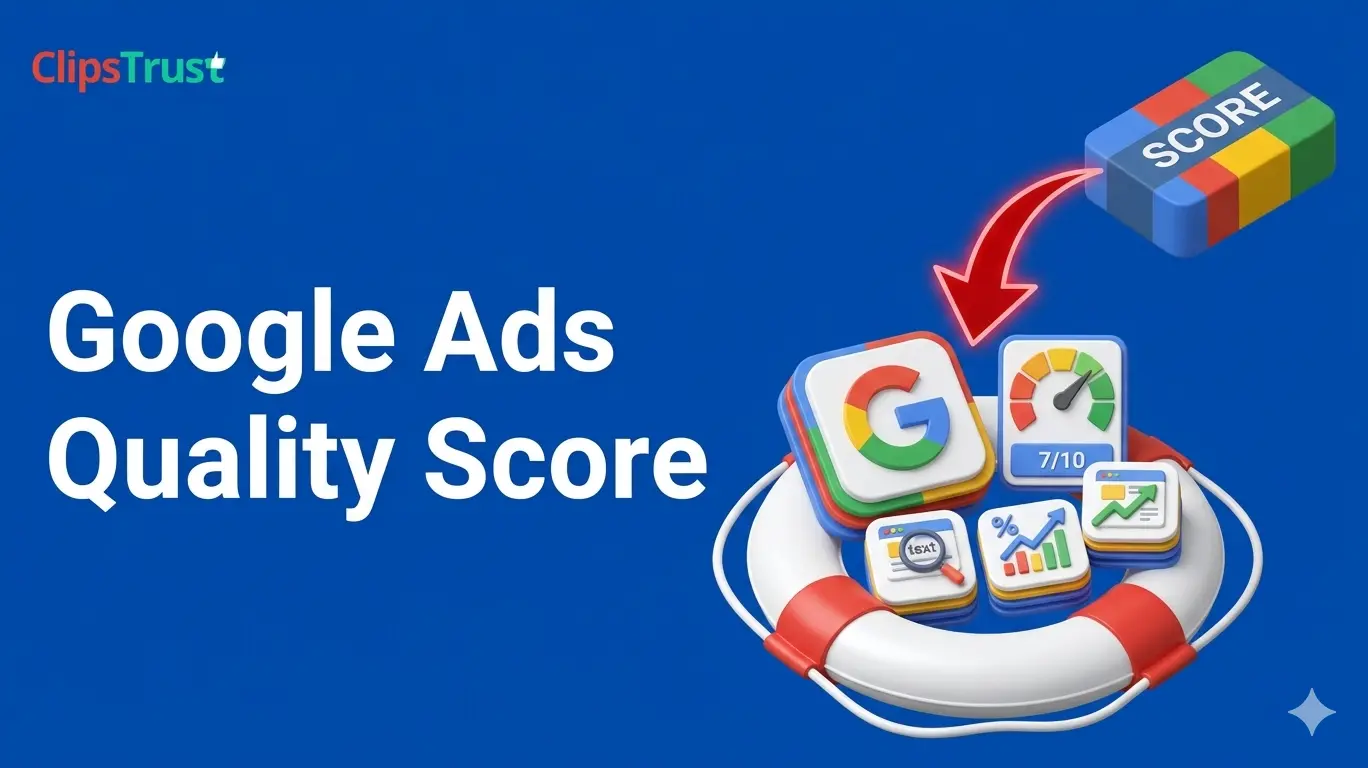
    google ad quality score

    The relationship is dramatic: a Quality Score of 10 can reduce your cost-per-click by up to 50% below the market rate. A Quality Score of 1 can increase your CPC to up to 400% above the market rate. For an advertiser spending Rs 50,000 per month, the difference between QS 3 and QS 7 could be the difference between generating 50 leads and 200 leads on the same budget.

    Quality Score is Google’s way of incentivising relevance: advertisers who provide the most useful, relevant experience for searchers get rewarded with lower costs and better positions. This aligns Google’s interests (delivering useful search results) with yours.

    The Three Quality Score Components

    ComponentWeightWhat Google MeasuresRated As
    Expected Click-Through Rate~35%How likely is this ad to be clicked relative to other ads for the same keywordAbove Average / Average / Below Average
    Ad Relevance~35%How closely does the ad copy match the intent behind the search queryAbove Average / Average / Below Average
    Landing Page Experience~30%How relevant, fast, useful, and trustworthy is the landing page for users who clickAbove Average / Average / Below Average

    How to check your Quality Score: In Google Ads, go to Keywords ? Columns ? Modify Columns ? Quality Score. Add Quality Score plus all three component columns (Exp. CTR, Ad Relevance, Landing Page Exp.) to your keywords view.

    Quality Score vs CPC — The Financial Impact

    Quality ScoreCPC AdjustmentExample (Rs 50 benchmark CPC)Action Required
    10—50% (50% below average)Rs 25 per clickMaintain — excellent performance
    9—44%Rs 28 per clickMaintain — excellent
    8—37%Rs 31 per clickMaintain — above average
    7—28%Rs 36 per clickGood — minor improvements possible
    6—17%Rs 41 per clickAcceptable — optimisation opportunity
    5AverageRs 50 per clickAverage — review component scores
    4+25% above averageRs 62 per clickBelow average — needs improvement
    3+67% above averageRs 83 per clickPoor — urgent improvement or pause
    2+150% above averageRs 125 per clickVery poor — pause or restructure
    1+400% above averageRs 250 per clickWorst — pause immediately

    How to Improve Each Quality Score Component

    Improving Expected Click-Through Rate

    Expected CTR measures how likely your ad is to be clicked compared to other ads for the same keyword. Google calculates this based on your historical CTR data and industry benchmarks.

    • Include the exact keyword in your headline: When your ad headline matches what the user searched, Google bolds the matching words, making your ad stand out
    • Lead with benefits, not features: “Get 3x More Leads in 90 Days” outperforms “Digital Marketing Services Available”
    • Use numbers: “500+ Clients, 8 Years Experience” — specific numbers increase credibility and CTR
    • Use action words: Get, Discover, Start, Book, Claim — verbs drive clicks
    • Add urgency: “Limited Spots Available”, “Free Audit Ends This Week”
    • Use all 15 headline slots: More headlines give Google more combinations to test — high-performing combinations emerge over time
    • Pause ads with CTR below 1%: Low-CTR ads drag down the entire ad group’s Expected CTR score

    Improving Ad Relevance

    Ad Relevance measures how closely your ad copy matches the intent behind the keyword being searched. The most common cause of “Below Average” ad relevance is having too many different keyword themes in one ad group.

    • Use tight single-theme ad groups: Each ad group should have 3–10 keywords all targeting the exact same user need
    • Mirror keyword language in ad copy: If your keyword is “SEO services Noida”, your headline must say “SEO Services in Noida” — not just “Digital Marketing Solutions”
    • Use Dynamic Keyword Insertion (DKI) carefully: {KeyWord:Default Text} inserts the searched keyword into your ad headline automatically — powerful for relevance but review all keyword combinations first
    • Address the specific intent: Transactional keywords (“hire SEO agency”) need ads with offers and CTAs. Informational keywords (“what is SEO”) need educational framing

    Improving Landing Page Experience

    Landing page experience is often the easiest component to improve dramatically because many advertisers send all ad traffic to a generic homepage.

    Landing Page IssueImpact on QSFix
    Sending all ads to homepagePoor — homepage is rarely relevant to specific keywordsCreate dedicated landing pages per ad group theme
    Page loads over 3 secondsBelow Average — Google factors in Core Web VitalsCompress images, use CDN, reduce render-blocking JS
    No mobile optimisationBelow Average — mobile is primary for Indian usersEnsure responsive design; test on real 4G speeds
    Content does not match adPoor — keyword mismatch between ad and pagePage content must include the keywords and topic of the ad
    Intrusive pop-ups on arrivalBelow Average — degrades user experience scoreRemove immediate pop-ups; use exit-intent or delayed triggers
    Missing clear CTAAverage at best — users bounce without a clear actionOne primary CTA above the fold: call number, fill form, click button

    Diagnosing Low Quality Score Keywords

    When you find a keyword with QS below 5, use this diagnosis process:

    1. Check all three component scores (Expected CTR, Ad Relevance, Landing Page Exp.)
    2. If Ad Relevance is Below Average: Move the keyword to a new single-theme ad group with dedicated ad copy that specifically addresses that keyword’s intent
    3. If Expected CTR is Below Average: Rewrite ad headlines to include the keyword, lead with stronger benefits, and pause the lowest-CTR ad
    4. If Landing Page Exp. is Below Average: Create a new landing page specifically for that keyword theme, or substantially improve the existing page content
    5. If all three are Below Average: Pause the keyword. It is too broad or irrelevant for your business — add it as a negative keyword to prevent future spend

    Expert Insight — Google Ads Quality Score Optimisation

    Chirag Arora

    Chirag Arora — #1 PPC Expert in India

    One of India’s most sought-after digital marketing experts specialising in Google Ads, PPC strategy, and paid media management. Verified on ClipsTrust.

    View Profile

    PulsePromote — #1 PPC Agency in India

    India’s leading performance marketing agency based in Noida. Google-certified PPC experts delivering data-driven campaigns with guaranteed ROI.

    View Profile

    Frequently Asked Questions — Quality Score

    Quality Score is Google’s rating (1–10) of how relevant and useful your keyword, ad, and landing page are to a user who searches for that keyword. It is calculated based on three components: Expected Click-Through Rate (how likely your ad is to be clicked), Ad Relevance (how closely your ad matches the search intent), and Landing Page Experience (how relevant and user-friendly your landing page is for users who click). Quality Score directly affects both your ad position and your cost-per-click.

    Quality Score has a direct multiplier effect on your cost-per-click. A Quality Score of 10 can reduce your CPC by up to 50% compared to the average. A Quality Score of 1 can increase your CPC by up to 400% above average. For example, if the benchmark CPC for a keyword is Rs 50, a competitor with QS 10 might pay Rs 25 while a competitor with QS 1 pays Rs 200 for the same position. This means improving Quality Score is the single most cost-effective way to reduce Google Ads spend without reducing traffic volume.

    A Quality Score of 7 to 10 is considered good and results in below-average CPCs. Score of 5 to 6 is average and means market-rate CPCs. Score of 3 to 4 is below average with higher-than-market CPCs. Score of 1 to 2 is poor and means very high CPCs with limited ad impressions. Most advertisers should target a minimum Quality Score of 7 for all active keywords. Keywords below 4 should be either improved or paused.

    Improve Quality Score through three actions matching each component: (1) Expected CTR — write more compelling ad headlines that match search intent; use numbers, specific benefits, and power words. (2) Ad Relevance — use tight single-theme ad groups where keywords, ad copy, and landing page all use the same language and address the same intent. (3) Landing Page Experience — ensure your landing page loads in under 2 seconds, is mobile-friendly, and contains content directly relevant to the keyword being searched.

    Yes, Quality Score is a major component of Ad Rank, which determines your ad position. Ad Rank = Max Bid x Quality Score x Expected Extensions Impact. This means a lower bid with a high Quality Score can outrank a higher bid with a low Quality Score. This is Google’s incentive for relevance — advertisers who provide the best user experience pay less and rank higher. An advertiser with QS 8 bidding Rs 40 can outrank an advertiser with QS 4 bidding Rs 60.

    Landing page experience (part of Quality Score) measures how relevant, useful, and fast your landing page is for users who click your ad. Google evaluates: whether the landing page content closely relates to the ad and keyword, page loading speed (LCP under 2.5 seconds), mobile-friendliness, ease of navigation, and absence of intrusive pop-ups or irrelevant content. A “Below Average” landing page experience is one of the most common Quality Score killers — sending all ads to your homepage instead of specific relevant landing pages is a frequent mistake.

    Quality Score can change within 24–72 hours after making improvements, but meaningful changes typically take 1–2 weeks to reflect as Google gathers new statistical data on CTR and user behaviour. Landing page improvements (speed, content) take effect within days. Ad copy improvements take 1–2 weeks as Google needs click data to recalculate Expected CTR. Structural improvements (tightening ad groups) show improvement faster since the alignment between keyword, ad, and landing page improves immediately.

    Account-level Quality Score (historical account performance) is an unofficial but real factor in how Google treats new keywords in your account. Accounts with consistently high Quality Scores on existing keywords tend to start new keywords with higher initial scores. Accounts with poor Quality Score history and many low-performing keywords may find new campaigns start with lower scores. Pausing consistently poor-performing keywords and improving the overall health of your account improves your position for new campaigns.

    Conclusion

    Quality Score is the most financially impactful metric in Google Ads. A QS improvement from 4 to 8 can halve your cost-per-click while maintaining or improving ad position. The three levers are: Expected CTR (write compelling, keyword-matched headlines), Ad Relevance (tight single-theme ad groups), and Landing Page Experience (dedicated, fast, mobile-friendly pages matching each keyword theme).

    Check your Quality Scores weekly. Pause keywords below QS 3 immediately. Restructure ad groups where Ad Relevance shows Below Average. Build dedicated landing pages where Landing Page Experience is the drag. Even small QS improvements compound into significant budget savings over months of campaigning.

    Continue the PPC series: PPC Bidding Strategies ? Best PPC Tools ? What is PPC?

    Related Posts

    Alternate Text
    Create trends that set your business apart and attract a wider audience. Connect with potential customers by showcasing your unique offerings, building credibility, and personalizing every interaction.
    Share

    Leave a Comment